


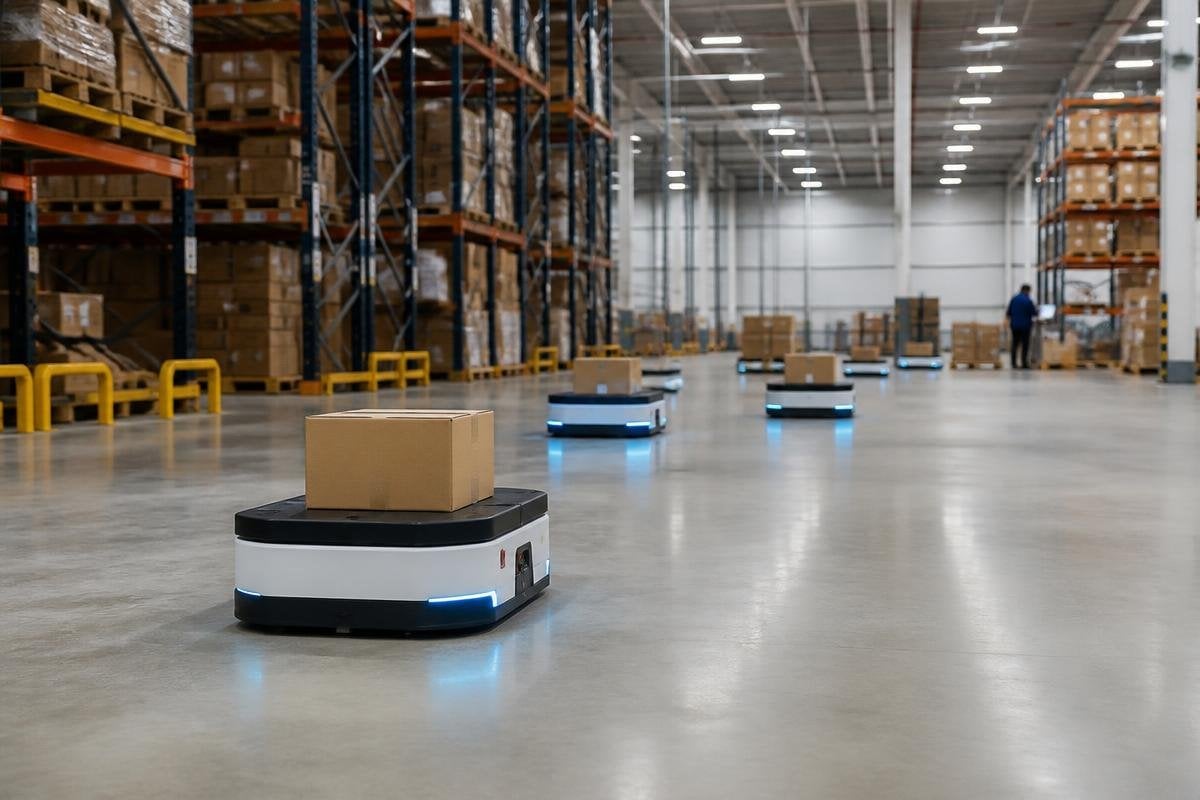
A warehouse robot can make a local decision in milliseconds, while a cloud service can compare data from machines spread across many sites. Cloud robotics joins those jobs without asking every robot to send every motor command over the internet.
Quick read
- Local computers handle movement, sensors, and safety stops.
- Cloud services can share maps, software, and fleet data.
- Slow networks, outages, security, and data costs still limit the design.
What cloud robotics means
A cloud robot has computing links beyond its own body. The robot may send logs, images, map updates, and task results to a remote service. That service can return a new route, a software update, or a work order.
The robot still needs local control. A camera feed may take too long to reach a distant server before the robot reacts to a person or a falling box. Local computers handle the fast loop: reading sensors, checking motor positions, and stopping movement.
The cloud handles work that can wait. It can store long-term records, compare performance across a fleet, and run large training jobs. This split gives each part a clear job, so a network delay doesn’t turn into a collision.
How machines share useful data
A fleet needs a common way to describe its state. That state may include location, battery level, task status, error codes, and sensor health. Software interfaces called application programming interfaces, or APIs, let different systems exchange that information.
Robotics teams may use tools such as ROS 2 for robot software and MQTT for lightweight message exchange. The tools don’t make machines compatible by themselves. Teams still need shared names, units, time stamps, permissions, and rules for handling missing data.
A shared map shows why this matters. One robot can detect a blocked aisle and send the change to a fleet service. Other robots can receive that update instead of finding the same blockage one at a time.
Older map versions also let an operator trace when a blockage entered the shared record. Reports at Robot24.com can put named robots, cloud services, and dated fleet tests beside that claim, so you can judge whether shared data cuts repeat work. The next section looks at what a connected fleet can gain.
What a connected fleet can gain
The most useful benefit is shared knowledge. A robot that sees a new obstacle, a worn wheel, or a low battery can send a record to software used by the rest of the fleet.
The same setup can reduce repeated work. A cloud service may send one tested software package to many robots, while local computers check whether each robot has the right hardware and configuration. A deployment team can then see which machines updated and which ones stopped with an error.
Cloud links can also help when a site has limited staff. An operator may review a camera view, error log, or map from another location. That does not remove the need for people near the machines, especially when a robot needs physical repair.
Where the plan breaks
Network loss is the first limit. A robot must keep safe behavior when the connection drops, and it needs enough local data to finish or pause its task. Cloud control works best for planning and records, not for every steering correction.
Security grows harder as more machines connect. Each robot needs an identity, access rules, signed software, and a way to remove access after a device leaves service. A stolen password should not give one person control of an entire fleet.
Data also costs money and computing time. Sending raw video from millions of machines would create a large storage and network load. Local filtering can send events, measurements, or short clips instead, but that choice may leave out details needed for later analysis.
Privacy adds another limit. Cameras inside homes, hospitals, and workplaces may record people who never agreed to be part of a robot dataset. A system needs clear retention rules and a reason for collecting each type of data.
I’d keep safety and motion control on the robot until a cloud link has earned a stronger role through repeated tests.
A practical design check
Before connecting a robot fleet to cloud services, check these points:
- Local safety: Can the robot stop and hold position without a network connection?
- Data choice: Does the cloud receive useful events instead of every raw sensor stream?
- Software control: Can operators approve, pause, and reverse an update?
- Access limits: Does each robot have its own identity and permissions?
- Service plan: Who repairs a machine when the remote link or local computer fails?
Those answers decide whether the cloud saves work or adds another failure point. Millions of connected machines would need shared data rules, local safety systems, and repair plans that keep working when the internet does not.
